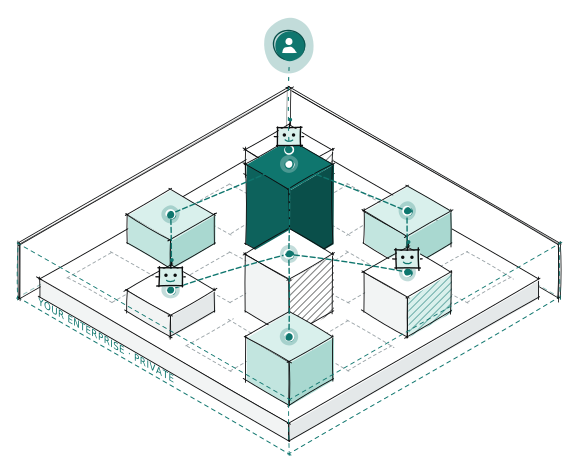
Your enterprise already holds what it needs to see, decide and act. We place sense points where the work happens and connect them, so intelligence forms inside your own walls, on your own data. Our products work this way, and our team works alongside yours to put them in place and keep them running.
Cloud accounts, identity systems, thousands of services and decades of data. Every year the city grows, and every year the people who look after it are asked to do more with the same hands.
Now powerful models have arrived on both sides of the wall. They write code, read logs and can even help reconstruct how old software works. They also let an attacker find a weakness in minutes that once took weeks. As software becomes easier to replace, the data inside it becomes the thing that matters most.
Intelligence bolted on from outside never knows your enterprise as well as your own systems do. It has to grow from inside, with a person accountable for every decision it makes.
ScaleMore systems than any team can watch by hand.
SpeedAttacks and changes now move at machine pace.
AccountabilitySomeone still has to own every decision.
Products
Problems enterprises keep facing.
Each product began with a problem enterprise teams described to us again and again. Here is what each one looks like, and what changes when the product is in place.
WhiteHats · Security operations
The defenders' answer
It is two in the morning on a Sunday. Somewhere, an attacker points a powerful model at your company. It reads your public code, maps your cloud accounts and tries your login pages, over and over, without getting tired and without needing a team.
Your security team is small, and asleep. On Monday they will open a queue of alerts that no one can finish. The attacker needed one weakness. Your team has to find all of them, across an estate that grows every week.
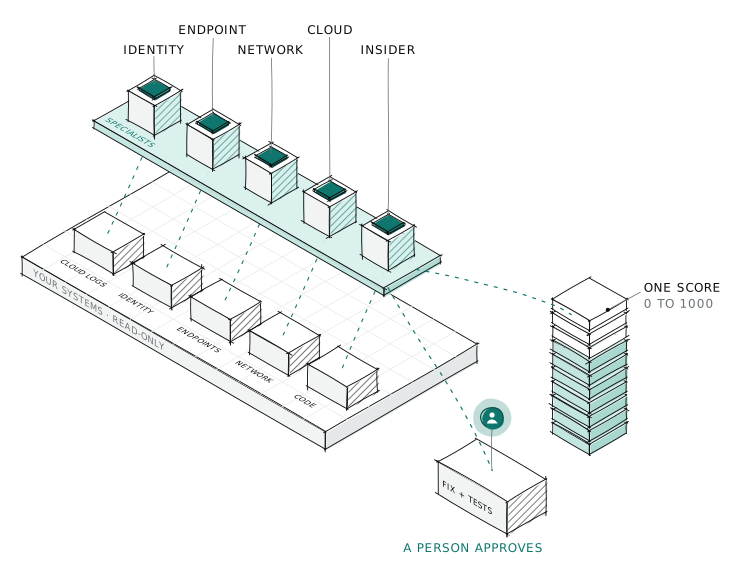
If attackers now have tireless machines, defenders should too. WhiteHats is a team of small specialists, each watching one part of your estate: identity, endpoints, network, cloud and insider activity. They compare notes, turn what they see into one posture score, and when something needs fixing, they prepare the fix and prove it against your own tests.
The outcome
Monday starts with a short list of decisions instead of a wall of alerts. Nothing changes in your systems until a named person on your team approves it. The board gets a number it can follow, and auditors get a record of who approved every change.
Read-only sources, five specialists, one score, and fixes that wait for a person
Converge · Data migration
The system you cannot leave
Your teams have run on the same ticketing tool for more than a decade. It holds years of issues, comments, attachments, links between projects and the history of every decision. Everyone agrees it is time to move.
Replacing the software has never been easier: modern tools can now help reconstruct how an old system works. The data is another matter. By hand, the move takes months of exports, scripts and spreadsheets, and the quiet errors, such as a field mapped to the wrong place, a broken link or a record left behind, surface after the old system is switched off. So many enterprises stay where they are.
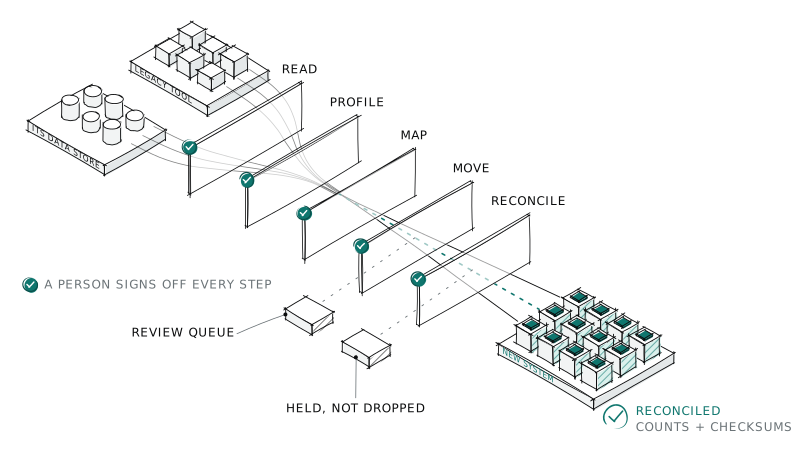
Converge moves the data out piece by piece. It reads the old system, profiles what the data really contains, maps every field and link to the new system with a confidence score, and moves one project, team or year at a time. Clear matches move quickly, unclear ones go to the person who knows, and records that do not fit are held for review, never dropped.
The outcome
Each piece is reconciled with counts and checksums before the next one begins, and every mapping decision carries a named approver. The old system can be retired on a plan, with nothing lost. The same approach brings two companies' systems together after an acquisition.
Piece by piece, signed off at every step, with every record accounted for
Data Modeler · Synthetic data
The data you cannot touch
Your engineers are ready to test a new payments flow. The data they need sits behind approvals and a privacy review, for good reason: it belongs to your customers.
So the testing happens on a handful of hand-made rows, and the bugs that matter arrive in production. Copying production data would be faster, and it is exactly the risk your compliance team exists to prevent.
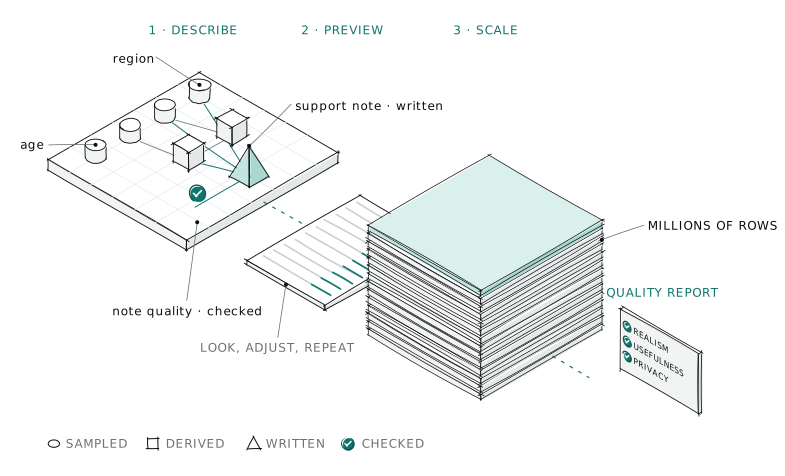
Describe the data you need, column by column. Check ten rows. Then generate millions that behave like the real thing: amounts that fit the plan, dates that follow each other, and free text that matches the numbers beside it, with no real record inside.
The outcome
Releases move faster, demos look real without exposing anyone, and models are trained on data that carries no customer's details. Every dataset arrives with a report on realism, usefulness and privacy.
Describe the columns, preview a handful of rows, then scale with a quality report
In development
The next product is already being built.
The portfolio grows one enterprise problem at a time. If your teams still carry heavy, high-risk work by hand, tell us about it. It may be what we build next.
A product is where it starts. Partnership is how it lands.
Enterprises do not need another tool to install and forget. They need it working inside their environment, with their people. That is where we stay involved.
Implementation with your team
Our engineers work alongside yours to connect systems, configure policies and take the product into production on your infrastructure.
Custom builds for your use case
When your problem does not fit a product exactly, we adapt one, or build on the same foundation, for the way your enterprise works.
Ongoing operation
After go-live we stay: monitoring, tuning and regular reviews, with your team in control of every decision.
How an engagement runs
Technical session
We review your environment, objectives and constraints, and give a clear view on fit.
Success criteria
Before a pilot begins, both sides agree measurable success criteria in writing.
Agreed by both sides
Pilot
The product runs on your data and systems, with our team alongside yours.
Production
A readiness review, sign-off from both sides, and operating documentation for your team.
Signed by both sides
Operate
Monitoring, tuning and reviews, and new needs folded back into the product.
Principles
Principles behind every product.
They apply to every product in the portfolio, including the ones still to come.
Accountability stays with people
Agents can do the work, but responsibility cannot be delegated to them. Every consequential action is approved by a named person, and the record shows who approved what, and when.
Evidence with every output
A fix arrives with passing tests. A migration arrives with reconciled counts. A dataset arrives with its quality report.
Customer data stays under customer control
Read-only access by default, a separate encryption key for each customer, and an access log for every session.
Built for operations
Audit trails, health checks, upgrades and written guides from the first release, so your own team can operate it.
Book a demo
Bring us your hardest operational problem.
Share a few details about your organisation and objectives. We will confirm a time, tailor the session to your environment and tell you plainly whether we can help.
Next steps We confirm a time and agree an agenda based on your requirements.
We build products for demanding work in enterprise security and data, then work alongside your team to put them in place, adapt them and keep them running. Today that means WhiteHats for security operations, Converge for moving data out of legacy systems and Data Modeler for realistic synthetic data. More products are in development.
What do you mean by native intelligence?
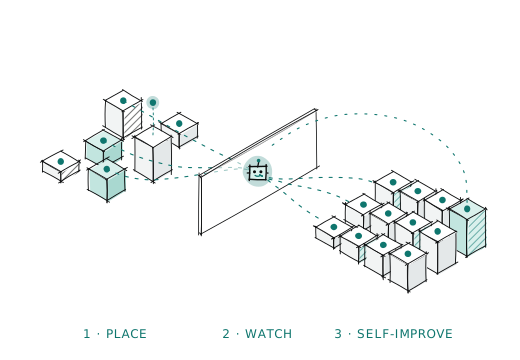
Intelligence that grows inside your enterprise instead of being bolted on from outside. We place sense points where the work happens and connect them. Agents then watch and improve on your own systems and your own data, with a person accountable for every decision.
Does our data leave our environment?
No. The products run inside your environment and read your systems with read-only access by default. Each customer has a separate encryption key, and every session is logged.
Will the products change anything without our approval?
No. Agents prepare the work, such as a security fix with passing tests or a migration step with reconciled counts, and a named person approves it. The record shows who approved what, and when.
Which systems do you work with?
WhiteHats reads from AWS, Azure, Google Cloud, Okta, Microsoft Entra ID, Google Workspace, GitHub, CrowdStrike and Jira. Converge moves data out of legacy tools such as Jira, piece by piece. Data Modeler works from a description of your data, so it needs no access to real records. If your system is not listed, ask: connecting new ones is part of implementation.
How does an engagement start?
With a technical session about your environment and objectives. We then agree success criteria in writing, run a pilot on your data and systems with our team alongside yours, and move to production once both sides sign off.
Can you help with a problem that does not fit your products?
Yes. When a product does not fit exactly, we adapt it, or build on the same foundation for the way your enterprise works.
What happens after go-live?
We stay involved with monitoring, tuning and regular reviews, and we provide written guides so your own team can operate the product too.
How do we see a demo?
Use the form above or write to hello@nativesense.si. We confirm a time and tailor the session to your environment.